
 Emily Chan
In an era defined by rapid digital acceleration, companies across industries are grappling with a familiar challenge: how to modernize fast enough to stay competitive without building systems that become outdated just as quickly. As organizations look toward 2025, “sustainable IT” technology designed for longevity, adaptability, and ethical use is emerging as a top priority.
One of the companies pushing this conversation forward is MIST Global, an IT services and AI solutions provider founded and led by CEO Sreejith GS Mr. Nair. With more than two decades in digital transformation, Mr. Nair has focused the company on creating technology ecosystems that aren’t merely efficient, but built to last.
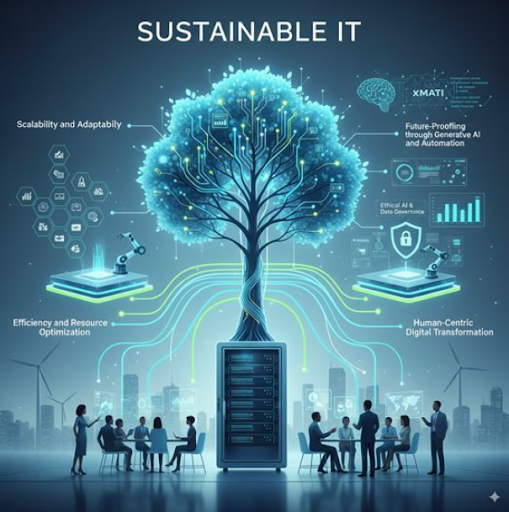
A Shift Toward Long-Horizon Technology Planning
The concept of “sustainable IT” has gained momentum as businesses confront rising infrastructure costs, regulatory pressures, cybersecurity risks, and the rapid evolution of artificial intelligence. For many organizations, the question is no longer whether to modernize, but how to build systems capable of evolving continuously.
Mr. Nair argues that the answer lies in designing digital environments with adaptability at their core. “Technology shouldn’t trap companies into rigid paths,” he often emphasizes in industry discussions. “It should give them room to grow.”
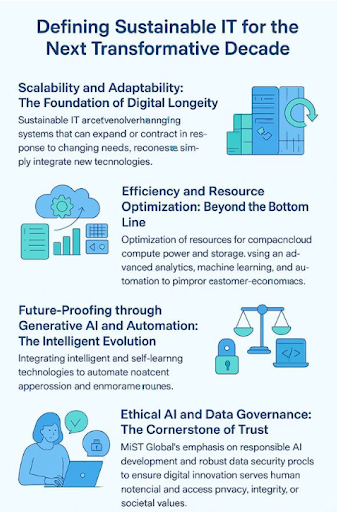
At MIST Global, this principle translates into architectures that can scale up or down without disruption, integrate new tools quickly, and shift direction as markets and technologies evolve.
Driving Efficiency With Intelligent Automation
Another cornerstone of the company’s approach is a focus on intelligent resource optimization. Cloud deployments, development pipelines, and data operations are examined through the lens of efficiency not simply to cut costs, but to reduce operational waste and streamline output.
MIST Global uses advanced analytics and machine learning to automate repetitive tasks and fine-tune how organizations allocate their digital resources. The company positions this not as a cost-saving tactic but as a strategic move that frees teams to spend more time on creative and high-impact work.
The Role of Generative AI in Modern Infrastructure
The rise of generative AI is reshaping how enterprises build and maintain technology. MIST Global’s AI platform, xMATI (xmati.ai), reflects this shift, offering tools that help development teams generate code, solve troubleshooting tasks, produce content, and automate various operational processes.
Rather than promoting AI as a replacement for human expertise, the company focuses on how automation can enhance existing teams. The goal, Mr. Nair says, is to help organizations innovate faster while preventing systems from becoming obsolete.
Ethical AI and Data Governance Move to the Forefront
As companies integrate AI deeper into their operations, concerns over data privacy, algorithmic bias, and transparency have become critical. MIST Global frames these issues as essential components of long-term digital stability.
The company emphasizes responsible AI design, explainability, and strict data governance protocols. In an environment where data breaches and AI missteps can carry significant reputational and financial consequences, these practices are increasingly seen as non-negotiable.
Keeping People at the Center of Digital Transformation
While automation and AI dominate much of the industry narrative, MIST Global stresses the importance of designing systems that elevate human work. The company’s human-centered approach focuses on improving usability, user experience, and cross-team collaboration.
“Technology should feel intuitive,” Mr. Nair has said in past interviews. “When people can use tools easily, innovation follows naturally.”
This philosophy positions digital transformation not as a purely technical project, but as a cultural one ensuring that employees stay engaged and empowered through every stage of change.
Preparing for the Digital Demands of 2025 and Beyond

Looking ahead, MIST Global is positioning itself as a strategic partner for enterprises seeking to build resilient technology ecosystems. Its focus on scalability, automation, ethical AI, and human-centered design aligns with a broader shift in the industry toward long-term digital durability rather than short-term upgrades.
As businesses navigate the next wave of technological change, companies like MIST Global are helping shape what sustainable IT will mean in practice and how organizations can build systems that grow with them, rather than hold them back.
References
1. CIO Magazine. “Sustainable IT: Why Long-Term Digital Planning Matters,” CIO, 2024.
2. Frontiers in Psychology. “Sustainable Leadership: A Literature Review and Prospects for Future Research,” Frontiers, 2022.
3. Total Research Insights. “The Rise of AI-Driven Digital Transformation,” TRI Technology Report, 2023.
4. Gartner. “Adaptive Infrastructure and the Future of Enterprise Technology,” Gartner Insights, 2024.