
 admin
admin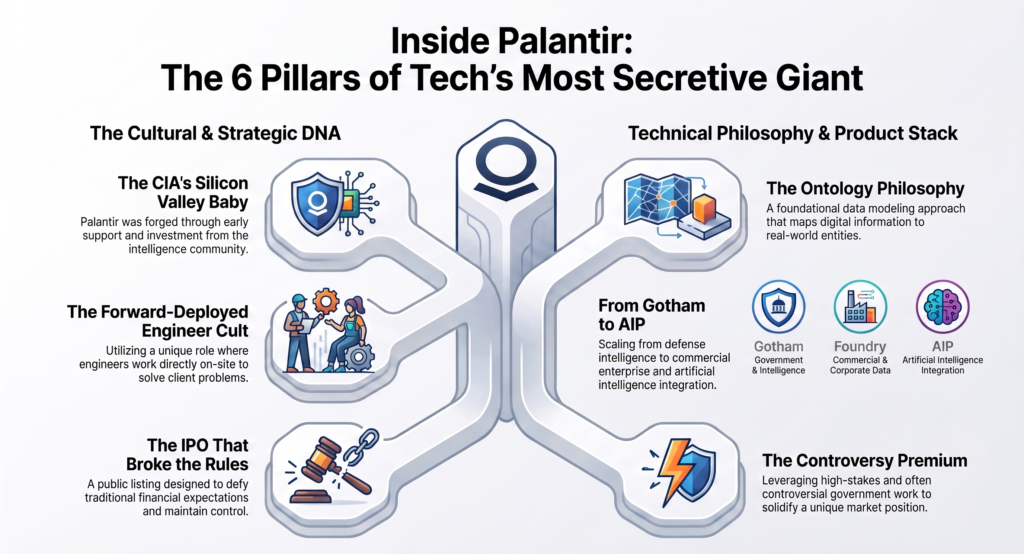
NDA agreements and government classifications have prevented people from having any idea of what makes Palantir Technologies tick. In fact, aside from a few publicised facts about Palantir, such as its stock price and government contracts, the structural DNA of the company can be considered quite hidden.
The CIA’s Silicon Valley Baby
Actually, before Peter Thiel became the public face of Palantir, the idea was nurtured by American intelligence agencies. Around that time, the company was called Palantir. The CIA’s venture capital arm (In-Q-Tel) was one of the first investors of Palantir, and that happened way before the mainstream venture capital world even considered a software company catering to spies. Not only did they write a check but also that the CIA analysts worked with the Palantir engineers in the early stages of the company. They helped each other in building a very powerful platform which eventually was turned into Gotham.
Palantir started from a need in the counterterrorism environment of post-9/11 America that was more about identifying people across databases. Rather than aiming for quarterly earnings, the software was developed at an incredibly fast pace. Today, the intelligence community’s blood is visible in every line of the business, from the products offered.
The Forward-Deployed Engineer Cult
Palantir doesn’t use its regular salespeople. Rather, the company assigns what they call “Forward Deployed Engineers” (FDEs) to the task. These are technically proficient specialists who are completely integrated into the working space of the client’s organisation for several months or even for a few years. They are not consulting engineers like the ones at McKinsey. Rather, these software engineers work at client desks themselves, wear client badges and create client-specific software programs that run on top of Palantir’s platform. The secret? In most cases, Palantir ends up losing money because of the long duration of FDE deployment with a client. For example, the company might lose even millions of dollars when it places its teams within a potential client organisation. Palantir regards it as an investment of the future: if FDEs create a key asset for the client, then such a client is so deeply dependent on this that it’s functionally impossible to do without them. It’s an expensive, brilliant land-and-expand strategy disguised as technical support.
The Ontology Philosophy
Most platforms sort out information basically through databases, tables, and rows. In case of Palantir, they think about “ontologies” philosophical models about the nature of things and how they can be associated. In this reality ofPalantir, data is not a static storage but a living model of the real world, where the different things (people, objects, events) can enter into one another’s world by relating to each other, they possess characteristics or traits, and they exist at a certain point in time also.
This deep philosophy of things that co-founder, Stephen Cohen, brought along the road has caused Palantir not to be merely a repository of your data but it makes a model of the meaning in your words too, so to speak. The platform is, practically speaking, making an operational digital twin of the customer entity, which makes it very hard to move from it once you have implemented.
Gotham, Foundry, and the AIP Pivot
Industry observers often conflate Palantir’s products, but the distinction reveals the company’s evolution. Gotham is the original intelligence-community platform—dark-themed, link-analysis heavy, designed for hunting bad actors. Foundry, a product version, is a totally different rebuild meant mainly for enterprise supply chains and healthcare systems. However, the major secret weapon was launched very quietly in 2023: the Artificial Intelligence Platform (AIP). With AIP, organisations can roll out large language models and AI agents over their current Palantir infrastructure and at the same time keep their data governance strict. Palantir essentially built an enterprise operating system for AI before most companies understood they’d need one. The AIP bootcamps—intensive, multi-day sessions where Palantir builds working AI prototypes with potential clients—have become one of the most effective enterprise sales mechanisms in tech history.
The Controversy Premium
Palantir’s team has actively stirred controversies instead of shunning them. When activists raised their voices against the ICE contracts Palantir had made, the company publicly did not apologise. Instead, they used the situation to talk about making technology for Western defence and democratic values. The eccentric CEO of Palantir, Alex Karp, used the company’s different opinions as a way to promote it. Many tech CEOs try to stay politically non-involvement while others publicly express political preferences. Karp, on the other hand, holds philosophical lectures and has a habit of writing letters that sound more like declarations for certain views. This positioning has attracted defence departments and intelligence agencies worldwide who worry that mainstream cloud providers might deny them service. Palantir has effectively branded itself as the tech company that won’t cancel you—a surprisingly valuable position in an increasingly polarised world.
The IPO That Broke the Rules
Palantir raised a lot of eyebrows when it launched the market in 2020. Its decision to neither opt for an ordinary IPO nor a popular SPAC surprised people. They went for a direct listing and at the same time, crafted a governance framework that allowed the founders nearly complete control. The “Class F” shares they had were endowed with 49.999999% voting rights, just a hair’s breadth below 50% for legal reasons, but practically dictatorial in control. They also included a “Founders’ Pledge” requiring the company to consider stakeholders beyond shareholders, essentially codifying their contrarian philosophy into corporate governance. Wall Street hated it. Retail investors loved it.
The Real Secret
The deepest secret of Palantir isn’t technical at all—it’s structural. The company has built a moat not through patents (they have relatively few) but through data gravity. Once an organization integrates its operations into Palantir’s ontology, the switching costs become astronomical. It’s not just changing software; it’s changing how your organization understands itself. That cognitive lock-in is worth far more than any patent portfolio.
Palantir isn’t really a software company. It’s an operating system for institutions—and that’s a secret worth knowing.